This Week's Story
 click here to play audio
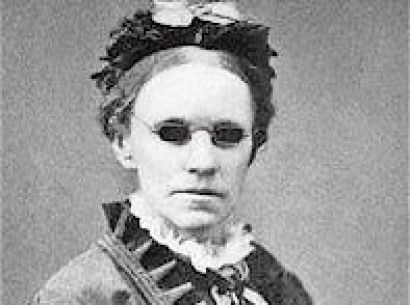
Fanny Crosby, blinded infant, becomes beloved composer!
This Week’s Story relives American history and the Bible through brief inspiring stories presented on mp3 audio recordings and text for reading.
Fanny Crosby: 1800's Queen of Gospel Hymns, part one
“Are you curious sometimes about who wrote the words for a song? As a kid, my sisters and I have often used a gospel songbook for singing and playing the piano.”
“I have done that! On the top or bottom of the songs there are the names of the people who wrote the songs’ words and music.’
“Yes, I have often seen the name Fanny Crosby as the lyrics’ writer. When I noticed the name repeatedly, I was told often, ‘Fanny Crosby was blind when she wrote the words of many songs.”
“I wonder how Fanny learned those skills.”
“I read short biographies about her. I was amazed to read that in her life Fanny wrote the words for about 9,000 hymns and more than 1,000 secular songs. Not all were published. At least 3,000 were published. An astonishing accomplishment!”
Fanny had the ability to write complex hymns. She had had formal composition and theory training, but she wrote not for critics or the admiration of skilled musicians.
She wanted common people to understand and be inspired by the words. Perhaps the best wording was a pop verse or the best music a pop tune. When she was criticized, she recognized that sometimes her secular or religious lyrics were not good quality. Some were shallow; some were excellent, met their purpose, and had a powerful simplicity.
Fannie knew and loved Italian opera. She was an excellent soprano singer, a good pianist, and an outstanding harpist. She was familiar with compositions by Beethoven, Chopin, and Mendelssohn. However, the gospel hymns had a simplicity and message that people loved!
How did a tiny blind girl become the Queen of Gospel Song? She can tell her story.
My mother, named Mercy, gave birth to me when she was twenty. I was christened Frances Jane Crosby at the Doanesburg Church. A month later my family knew something was wrong with my eyes. A local man claimed he was a doctor. I doubt that he was. He put hot poultices on my eyes. The pain was terrible for me, a baby. The infection left, but ugly white scars formed on my eyes.
We were not a lost sad family We had a strong faith, believing in God and the Bible; and we were Presbyterians.
Father died when I was a baby. We faced poverty. Mother hired herself to a wealthy family. Grandma Eunice spent each day with us. She was a wonderful encourager and teacher.
Our family was literate. We could read and write. We expected to get a few years of schooling, usually up to fifth or six grade. If our work was finished, we could read or write poetry by a fire on a winter night. We could recite by memory passages from famous classical writers like Milton, Shakespeare, and Homer. For sure, we read or had read aloud to us Pilgrim’s Progress by John Bunyan. We read regularly from the King James’s translation of the Holy Bible.
Part two will take us to evenings in the Crosby home and the revolution in Fanny when she began attending the New York Institution for the Blind.
Today’s presenters are Gwen Crawford, Alyce Steiner, Carlos Gamez. and myself, Barbara Steiner.
Investigate historical characters presented on thisweeksstory.com.
<< previous story]
We invite your comments! [click here to comment]
 Join the conversation.
This Week's Story is a non-profit supported by listeners. [click here to make a donation]